


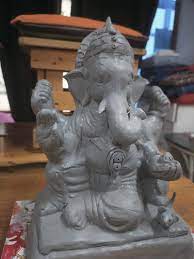
Traditional Sanctity: In Hinduism, crafting Ganesha idols from clay is a scriptural practice. It is believed that clay idols attract divine presence more effectively. As a natural material, clay causes no environmental harm during immersion, preserving the sanctity of religious practices.
Spiritual Symbolism: During Ganesha Chaturthi, clay idols dissolve completely in water, merging with nature. This symbolizes the life cycle, reflecting the principle of "from dust to dust," imparting a profound spiritual message.
Environmental Reverence: Hinduism regards nature as divine. Eco-friendly clay idols align with principles like the Prithvi Sukta, which emphasize Earth’s conservation, reinforcing the harmony between faith and nature.
Scientific Perspective:
Biodegradability: Clay idols are biodegradable, dissolving harmlessly in water without polluting the environment. In contrast, PoP idols, made from chemicals like calcium sulfate hemihydrate, do not dissolve and contribute to water pollution.
Water Ecosystem Safety: Scientifically, PoP immersion alters water pH levels, harming aquatic life. Clay idols, being natural, do not disrupt water bodies, ensuring ecological balance.
GoSriKi Women's Rayon Viscose Anarkali Printed Kurta with Palazzo & Dupatta
Non-Toxic Materials: PoP idols often use toxic chemical paints (containing lead, mercury, etc.), which are harmful to human health and aquatic ecosystems. Clay idols typically use natural dyes (e.g., turmeric, red earth), which are less hazardous.
Sustainable Production: Crafting clay idols is simple and requires minimal energy. PoP production involves chemical processes and high energy consumption, placing a greater burden on the environment.